Kathmandu 
Kathmandu, the capital and the largest city of Nepal, derives its name from Kasthmandap or "house of wood" a pagoda-style temple. A few steps away is the Temple of the Living Goddess, where the clients may catch a glimpse of the Kumari at one of the open windows overlooking the inner courtyard. All around the splendour of historical monuments is the hustle & bustle of the market place. Vegetable vendors, trees of flutes, salesmen with their wares displayed on their person, souvenir hawkers, street shop selling imported goods and tucked away in a quiet corner the glittering bead market for custom made bead necklaces.
Patan
Patan is also known as Lalitpur or the "city of fine arts" and is the oldest city in the valley. This Buddhist City is said to have been founded by Emperor Ashoka in the 3rd century BC. Patan is the cradle of arts and architecture of the valley, a great center both of the Newari Buddhist religion and of traditional arts & crafts with 136 bahals or courtyards and 55 major temples. Well known among these are the Krishna Mandir, Hiranya Varna Mahavihar, Kumbheshwar temple, Jagatnarayan temple & the Mahabouddha temple. Patan is enclosed within 4 Buddhist stupas set on the four-corners of the outer boundaries of this ancient city. A tour of Patan would also include a visit to the Tibetan refugee village to witness the hand weaving of Tibetan carpets using age-old methods of dyeing and finishing. Three or four persons at each loom weaving traditional designs, chatting & singing can also be seen here.
Bhaktapur 
Bhaktapur or Bhadgaon meaning the "city of devotees" lies 14 km east of Kathmandu. It is the home of medieval art & architecture and still retains its rich medieval aroma. A city of farmers, Bhaktapur is also known for it's pottery and weaving. Bhaktapur is the most charming and the best preserved of the valley’s three cities. The intricately carved temples, alleyways and timeless atmosphere of this place is simply intriguing. The major sightseeing places in Bhaktapur include Durbar Square, the Golden Gate, Palace of 55 windows, Bell of the barking dogs, Nyatapole Temple, Bhairavanath Temple, Dattatrya Temple, Pujari Math etc;
Bodhanath 
The stupa of Bodhanath lies 8 km east of Kathmandu. It is the biggest Stupa in Nepal and is located on flat land and encircled by houses & monasteries, where Rinpoches reside. This colossal Stupa is set on concentric ascending terraces in the powerful pattern of a Mandala. Around the base of this strikingly enormous and simple stupa is a ring of 108 images of the Buddha and 147 insets containing prayer wheels.
Bungmati & Khokana The twin villages of Bungmati & Khokana date from the 16th century and are located south of Kathmandu, down a rutty road dotted with Chaityas. Bungmati is the winter home of lord Rato Machhendranath, the protector God of Patan. The shrine of Karya Binayak is located between the two villages. At Khokana ancient oil presses can be seen at work in village houses.
Budhanilkantha 9 km north of Kathmandu in a small pond at the foot of the Shivapuri Hills lies the half-submerged massive black stone statue of the reclining Vishnu resting on a bed of snakes. Worshippers strew the sleeping Vishnu with offerings of flowers & rice. It is a monumental sculpture from the Lichhavi period.
Champa Devi The hike to the top of Champa Devi (2,278m), the highest peak on the Chandragiri Ridge south west of Kirtipur, affords a panoramic view of the west Kathmandu valley, back dropped by the snow covered Himalayas. Either starting from Chovar or from Pharping the trail climbs steeply to join at a saddle close to the top. A Hindu shrine and a white stupa mark the Champa Devi summit. Several return routes are possible. Staying close to the ridge continuing west, a trail descends from the second saddle north to Kirtipur. Another descends from the third saddle and reaches Kisipidi.
Chandeshwari Chandeshwari shrine is located north of the sprawling trading town of Banepa near Dhulikhel. A track leads northeast past the town hospital to the temple on the bank of a forested gorge. The temple is dedicated to Parvati, whom they called upon to slay ‘Chand’, the most fearsome of the demons. It thus became known as Chandeshwari, "the slayer of Chand". The main attraction is a remarkable fresco of Bhairav, painted on the western wall of the main structure. The torana and struts of the three-tiered temple are richly carved with the eight Astha Marikas, or "Mother goddesses" and eight Bhairavs.
Changunarayan 
The road access to Changunarayan, 18 kms east of Kathmandu is from behind Bhaktapur. Alternatively, it is a 45 minutes walk up from the Sankhu road, across the Manohara River, using the old pilgrim’s route or a pleasant half-day hike along the ridge from Nagarkote on the eastern valley rim. The lavishly decorated two-tiered temple was rebuilt after a fire in 1702, but the earliest inscription in the valley dated 467 A.D. testifies to the considerable talents of the Licchavi King Mandeva I, Nepal’s first great historical figure. The temple stands in a spacious courtyard, littered with priceless stone sculptures from the 4th to 9th century A.D. (Licchavi period). This golden age of classical Newari art produced masterpieces that were entirely religious in character.
Chapagaon A rough track to the south of the Kathmandu Valley winds steeply downhill, through intricately terraced fields of reddish brown soil to the ancient Lichhavi village of Lele, on through terraced mustard fields and bamboo groves to Chapagaon. An important tantric temple of Vajra Varahi is located here in a sacred grove of trees, built in 1665 – however, the site is much older. Various naturally sculpted stones strewn about are regarded as images of Ganesh, Bhairav and the Ashta Matrika.
Chovar Carved out of a hillside, the Chovar gorge is the only outlet for all the waters of the valley. Legend has it that Manjushree, an ancient saint cut the mountain with his magical sword, to drain out the water from the Kathmandu Valley which was then just a lake. There is a small but picturesque temple of Adinath on the top of the hill with a magnificent view of the snow capped peaks. Just beyond the gorge is a temple of lord Ganesh. The main image of the shrine is a massive rock, naturally carved.
Dakshinkali Dakshinkali is 45-minute drive south from Kathmandu. Located in a dark valley at the confluence of two streams, the shrine of Dakshinkali is the most spectacular of all Kali temples. Animal sacrifices are offered to this deity signifying fertility and the procreative powers of the Female, every Tuesday & Saturday. The animals are presented to the priest who will ritually decapitate them with a khukuri knife & bathe the black stone image of Kali in blood.
Dhulikhel 
30 kms east of Kathmandu lies the small resort town of Dhulikhel set on a hill top, enveloped in copper soiled terraces with magnificent views of the central Himalayan peaks. Dhulikhel is well known for its sunrise views and a number of day trails lead along the north ridge of the town. A good way to get a glimpse of Nepalese village life.
Godavari 18 kms south of Kathmandu lies the Royal Botanical Gardens at Godavari. With its rushing streams and shady meadows it is a popular picnic spot. It also has a notable collection of orchids, cactii & ferns. A quiet path leads to the Godavari Kunda, a spring where the sacred water of the Godavari river pours from the mountains.
Kakani The village of Kakani lies 29 kms north west of Kathmandu City. Famous for magnificent views of the sun setting over the north western Himalayan range; the Ganesh Himal massif, Gaurishankar (7,134 m), Choba Bhamare (6,016 m), Himalchuli (7,893 m), Annapurna (8,091 m). The drive to Kakani & back along the Trishuli Road is scenically rewarding with green forest & mountain grandeur on one side and fertile river flats and terraced hillside cultivation on the other.
Kirtipur Perched on twin hillocks and clinging to a saddle about 5 km south west of Kathmandu lies the village of Kirtipur. A long flight of steps leads up to Kirtipur from the valley floor & a motorable road goes part way up the hill. Steep paths link brick houses built on terraces. The villagers dressed in traditional costume work on ancient looms. The people are well known for their strength and valour. Many historical battles were fought and won by the inhabitants of Kirtipur.
Kopan Monastery A center of Mahayana Buddhism was established in 1969 by two Lamas; Lama Thupten Zopa Rinpoche & Lama Thupten Yeshe. Since its inception the center has been responsible for introducing thousands to Buddha's teaching through meditation courses, lectures & retreats.
Nagarkot 
The tiny settlement of Nagarkot clings to a hilltop 36 kms east of Kathmandu at an altitude of 2,099m. It is one of the best vantage point to view the peaks - from the Annapurnas to Everest, the peaks seem no more than a day's walk away. It is also possible to do a day hike from Nagarkot to Dhulikhel along the valley rim.
Nagarjun Nagarjun, a prominent forested hill, west of Kathmandu topped with a Buddhist stupa with superb views of Ganesh Himal, Langtang and the Kathmandu valley. A dirt road winds to the top (2,096m) though a trek would take two hours. A return trail descends the southwest side of Nagarjun to Ichangu Narayan and reaches Kathmandu via a dirt road that eventually comes out behind Swayambhunath.
Namo Buddha Namo Buddha meaning "hail to the Buddha" a sacred site, where according to legend Buddha sacrificed his body to feed a starving tigress & her cubs. A carved stone slab at the main stupa depicts the moving story. A dirt road (suitable for 4 wheel drive vehicles) leads up to Namo Buddha from Dhulikhel. A different trail returns descending south through a forest heading west up a long vale for a round trip walk of six to seven hours, or 2 to 3 hours to Panauti.
Panauti Located at the confluence of the Punyamati & Roshi Khola rivers, Panauti was once an important staging post on the Tibet trade route with pre-Lichhavi origins. The banks of the river are now crowded with temples, shrines and cremation ghats. Across the river lies the recently restored Brahmayani temple. The Indreshwar Mahadev temple is a 15th century Newari structure with exquisite woodcarvings especially on the roof struts.
Pashupatinath 
It is situated 5 kms east of Kathmandu on the banks of the sacred Bagmati River. The temple of lord Shiva, Pashupatinath, with a tiered golden roof & silver doors is famous for its superb architecture. Entrance to the temple precinct is forbidden to non-Hindus. The best view is from the terrace on the wooded hill across the river. The large gilded triple-roofed temple was built in 1696 AD though 300 years earlier there was a structure on this site. The Bagmati River is lined with dharmasalas and cremation ghats including a royal ghat reserved exclusively for members of the royal family. There is usually a cremation in progress on one of the platforms by the river, regarded as holy as it flows into the sacred Ganges. There are many occasions when the faithful take ritual purificatory baths in the river. One of the most colorful is the women's festival of Teej when dressed in their finest red and gold saris hundreds of women, laughing and singing converge on Pashupatinath.
Phulchowki The triple peaked hill of Phulchowki the "flower-covered hill", is highest on the valley rim at 2,762m. Lying 20 kms south east of Kathmandu, a road winds its way to the top where a small shrine is built to the mother of the forest, Phulchowki Mai. The trail up to the top takes about 4 hours through lovely rhododendron & oak forests crossing the motorable road a couple of times. Enjoy a breathtaking view of the white peaks from Himalchuli to the Everest. There is a trail connecting Phulchowki to Pharping on one side and Panauti on the other.
Sankhu Hills surround the sleepy village of Sankhu, once on the trade route east to Helambu. Forests above the village hide an important temple to the tantric goddess, Bajra Jogini. Follow the wide stone path north of the village and walk up the steps to the temple, flanked with smaller shrines, stupas and statues. The main structure is 17th century and has a fine golden torana above the door. Behind the temple there are other shrines & sculptures.
Shivapuri Shivapuri, at a height of 2,732m, allows one a 360 degree view of the Himalaya in the north & the Kathmandu valley in the south. The trail up to Shivapuri hill leads through small farming villages & a protected forest of Rhododendrons & orchids with little mountain streams running through it. This can be made into a most enjoyable full day's programme.
Swayambhunath Atop a green hillock west of Kathmandu stands the great stupa of Swayambhunath, a site over 2,500 years old marking the point where the legendary patriarch Manjushri discovered the lotus of the ancient Valley lake. For centuries an important center of Buddhist learning, the painted eyes of the Buddha gaze out from all four sides of the monument. Constructed to specific rules each with a symbolic meaning, the stupa of Swayambhunath is a model of its kind. Its’ dazzling white hemispherical mound represent the ladder to nirvana, itself symbolized by the umbrella on the top. The whole is hung with multi-colored prayer flags whose every flutter releases holy prayers. The faithful circumambulate the stupa clockwise, turning the banks of prayer wheels and even prostrating full-length in reverence.
Thimi A name derived from the world "Chhemi" meaning "Capable people" is well known for its colourful painted masks, dolls & for its terracotta work including delightful peacock & elephant flower pots and imaginatively moulded candle stands & ashtrays. This village of Thimi lies on the old road to Bhaktapur from Kathmandu.
Tika Bhairav A Shiva shrine of an altogether difference register is located at Tika Bhairav near Lele, where Shiva is portrayed in his terrible form as Bhairav. To reach this unusual shrine, the client must travel outside the Kathmandu Valley to the adjoining Lele Valley to the south. This monumental, multi colored fresco is an abstract close-up of Bhirav's face painted on a huge brick wall, barely sheltered by a tin roof.
The Four Ganesh Temples Ganesh, the elephant-headed god, is one of the most favored divinities in Hinduism and is certainly the most favored in the Kathmandu Valley. The god of good luck, who casts aside obstacles is believed to be the son of Shiva & Parvati. The shrew is his vehicle and he especially likes offerings of food. Ganesh has numerous shrines throughout the Valley but four are particularly sacred. The Chandra Binayak is in the middle of the village of Chabahil, 200m behind the Chabahil stupa. This small Ganesh is enshrined amidst rich brasswork & is believed to cure diseases and external bodily injuries. The simple stone Ganesh at the Surya Binayak is halfway up the foothills south of Bhaktapur. The path heads uphill to the little shrine, considered able to give the power of speech to young children who are slow to talk. In a forest preserve between the villages of Bungmati & Khokana lies the Karya Binayak. From the road linking the hamlets, a path leads up to a beautiful clearing and the walled compound of the shrine. Here Ganesh is an elephant-shaped stone and is believed to help complete difficult tasks. Those seeking strength of character go to worship the Ganesh at Jal Binayak, just beyond the Chovar Gorge. A beautiful brass shrew faces the massive rock that represents Ganesh in this triple roofed temple constructed in 1602 AD.
src="http://pagead2.googlesyndication.com/pagead/show_ads.js">


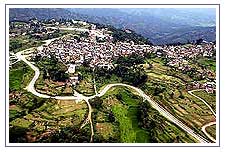 This ancient town is situated 30-km east of Kathmandu on the side of the Arniko Rajmarga (Kathmandu-Kodari highway). From here one can have a complete panoramic view of the snowy ranges from Karyolung in the east to Himalchuli in the west.
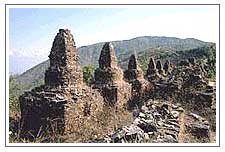 Helambu situated about 72-km north-east of Kathmandu is famous for its scenic grandeur and pleasant climate. There are many Buddhist monasteries amidst a rich and enchanting landscape. Sundarijal is the starting point to trek to Helambu which is mere 11-km away from Kathmandu.
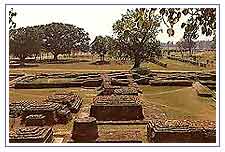 Lumbini is the birth place of Lord Buddha, the apostle of peace, and non violence. It is situated 250-kms south-west of Kathmandu. The broken Ashokan Pillar, remnants of old monastery, images of Buddha’s mother Maya Devi, etc. are still preserved in Lumbini. It is accessible by air from Kathmandu to Bhairahawa. Also one can reach Lumbini in about 3 hours by bus or car from Tensen via Bhairahawa. From Kathmandu it takes about 8 hours by bus or car.
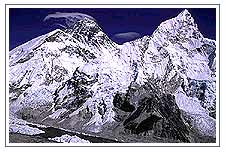 The name of namche bazaar is generally associated with that of Sagarmatha or Mt. Everest - the highest peak in the world. It is the entrance to the Everest region. Situated on the lap of Khumbu Himal range, Namche Bazaar is about 241-kms. From Kathmandu and the distance is generally covered within 15 days by trekking. This place is the home of the legendary Sherpas. One can fly from Kathmandu to Lukla and Syangboche in the Everest region.


 Posts
Posts